
It's not very often that the UK&I partner ecosystem gets its own benchmark. Data is usually folded into an EMEA figure, or partners end up measuring themselves against American numbers that don't always travel. That's a big part of why we commissioned our UK report, and it's also why we think the most useful thing a marketer can do with it is hold it up against their own business.
So, we've pulled the findings into six areas you can score yourself against. Think of it as a health check rather than an exam, because the point isn't to get top marks, it's to spot the one or two gaps worth fixing first.
Key takeaways
- UK partners invest 3.85% of revenue in marketing on average, with 62% investing 3-5%.
- Only 47.2% run basic reporting and 51.2% can measure marketing's contribution to pipeline.
- Three quarters have a documented plan, but only 45.6% say it's aligned to business goals.
- 38.8% have a director or owner covering marketing alongside another role.
- 60.6% of Co-op or MDF funded partners would cut back without Microsoft funding.
- For most partners, measurement is the gap that costs the most.
How to use it
For each of the six areas below, read the UK benchmark, answer the questions honestly for your own business, and give yourself a simple score: behind the market, in line with it, or ahead of it. If you can, get your MD to fill it in separately too, because comparing the two sets of answers is often more revealing than the scores themselves.
The six areas at a glance
| Area | UK benchmark from the study |
|---|---|
| Investment | 3.85% of revenue on average; 62% invest 3-5%; 25.2% invest 1-2% |
| Measurement | 47.2% run basic reporting; 43.6% run attribution; 51.2% can measure pipeline contribution |
| Planning | Three quarters have a documented plan; 45.6% say it's aligned to business goals |
| Resourcing | 38.8% have a director or owner covering marketing alongside another role |
| Differentiation | 27.6% say standing out from other partners limits their marketing |
| Funding dependency | 37.2% fund marketing from their own P&L; 60.6% of funded partners would cut back without Microsoft funding |
1. Investment
Most UK partners sit in the middle, with 62% investing 3-5% of revenue, but a quarter are down at 1-2% and only 12.4% get above 6%. Ask yourself what percentage you invest, whether that number was a deliberate decision, and whether your board would give the same answer as you.
2. Measurement
This is where the UK has the most room to grow. Fewer than half of partners run basic reporting, and almost half either can't connect marketing to revenue or aren't sure whether they can. Can you say where last year's new business came from? Could you show which activity influenced a specific deal?
3. Planning
Three quarters of UK partners have a documented marketing plan, but only 45.6% say it's pointed at what the business is actually trying to achieve. Is your plan written down, and does it start from the business's growth targets rather than a list of campaigns?
4. Resourcing
The most common way marketing is delivered in a UK partner isn't a marketing team at all; it's a director or owner covering it alongside another role, chosen by 38.8%. Competing internal priorities was the single biggest limit on partner marketing (30.8%), with headcount and in-house skills close behind (27.2%). Who owns marketing in your business, in one name, and how many hours a week does it genuinely get?
5. Differentiation
Building brand awareness in a crowded market was the top UK priority (27.2%), and 27.6% say difficulty standing out is holding them back. A quarter (25.2%) also named over-reliance on vendor-supplied material. Could a competing partner put the headline on your homepage onto their own site tomorrow without lying? If they could, it's a category description rather than a proposition.
6. Funding dependency
46% of UK partners ticked the Co-op box when we asked how marketing is funded, 44.4% said distributor-funded activity and 41.2% said MDF, while only 37.2% said their own P&L. Among partners funded by Co-op or MDF, 60.6% said their marketing would stop or reduce if Microsoft funding were withdrawn. What share of your marketing is genuinely yours, and what would stop tomorrow if the vendor money went away?
Reading your results
Very few partners will be ahead in all six, and that's absolutely fine. What you're looking for is the area where being behind costs you most. For most partners we speak to, that's measurement, because without it every other conversation - about investment, resourcing or funding - is built on guesswork.
Once you know your weakest area, you've got the start of a far stronger business case than "we need more budget". You can show the board where you sit against 250 partners like you, what that gap is costing, and exactly what you'd do to close it.
Where the full data lives
Every figure here comes from Microsoft Partner Marketing, Measured - The UK Edition 2026, where you'll also find the full question wording and data tables. And if you'd like to talk through your scores with somebody who works with Microsoft partners every day, we'd be glad to have that conversation, with no obligation at all.
See how your numbers compare
Microsoft Partner Marketing, Measured - The UK&I Edition 2026. What 250 UK&I Microsoft partners told us about how they market, how it's funded and whether any of it can be proven.
Download the report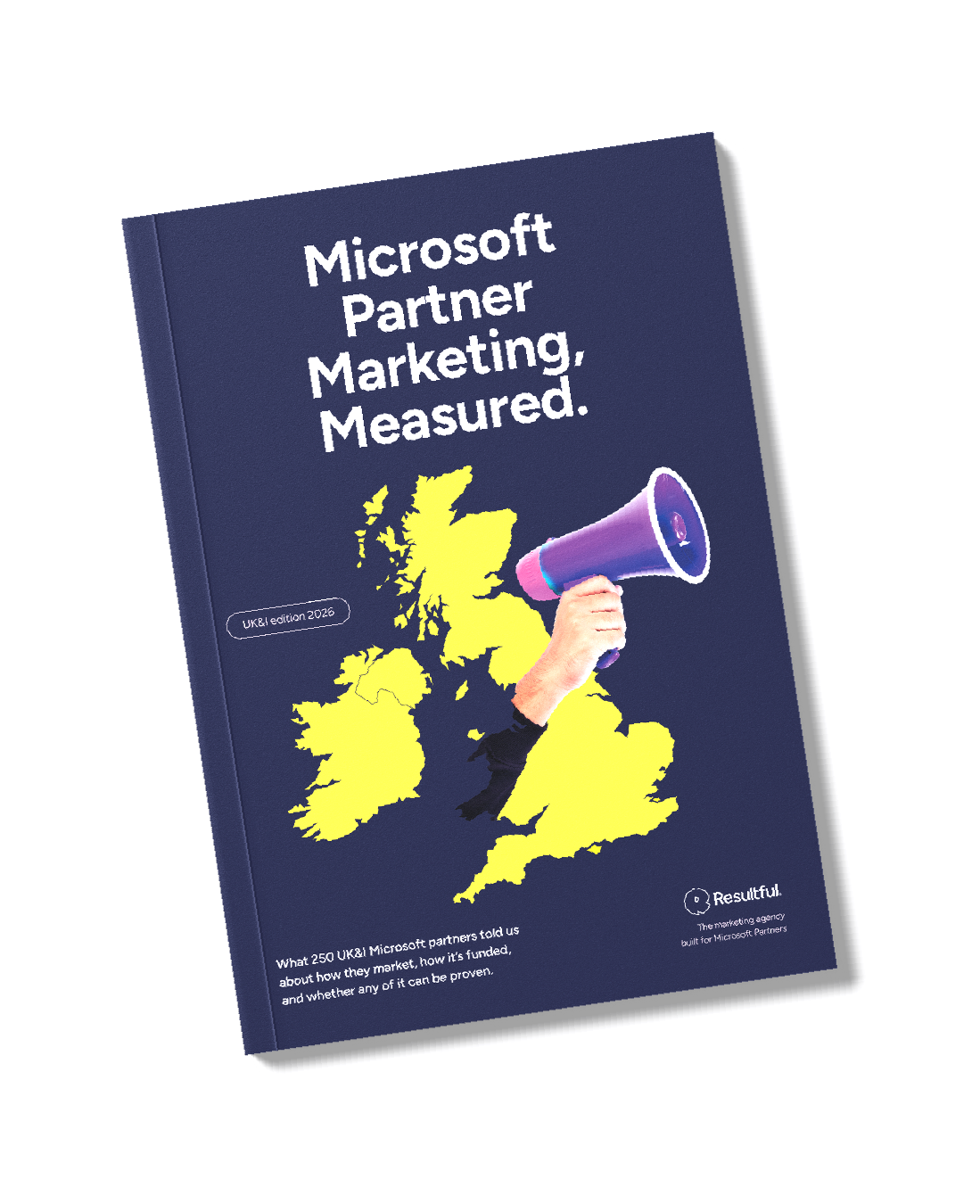
Frequently asked questions
How much do UK Microsoft partners invest in marketing?
3.85% of revenue on average. 62% invest 3-5%, 25.2% invest 1-2% and only 12.4% invest more than 6%.
How many UK partners can measure marketing's impact on revenue?
51.2% say they can measure marketing's contribution to pipeline and revenue, and only 47.2% run basic marketing reporting.
Who usually runs marketing in a UK Microsoft partner?
The most common setup, chosen by 38.8%, is a director or owner covering marketing alongside another role.
How dependent are UK partners on Microsoft funding?
Only 37.2% fund marketing from their own P&L, and 60.6% of Co-op or MDF funded partners say their marketing would stop or reduce without Microsoft funding.
Which area should I fix first?
The one where being behind costs you most. For most partners that's measurement, because investment, resourcing and funding decisions all depend on it.