
Very few businesses get handed marketing budget by somebody else, let alone the size of budget some Microsoft partners receive through Co-op, MDF and distributor programmes. It's genuinely a privileged position to be in, and when you're invested in the Microsoft mission, the conditions that come with that money are an easy pill to swallow.
But our latest UK research asked a question most partners would rather not think about, and the answer is one every partner leader should sit up and pay attention to.
Key takeaways
- 60.6% of Co-op or MDF-funded UK partners say their marketing would stop or reduce if Microsoft funding were withdrawn.
- 14.9% say it would stop almost completely.
- More UK partners fund marketing through Microsoft Co-op (46%), distributors (44.4%) or MDF (41.2%) than from their own P&L (37.2%).
- 39.4% of funded partners say their marketing would carry on regardless, or even increase.
- Use vendor funding as an accelerator on top of your own marketing budget, not as the whole engine.
What would happen if the money stopped?
We put this question to the 175 UK partners who told us Co-op or MDF funds their marketing: if Microsoft funding were withdrawn entirely, what would happen to your marketing? 60.6% said it would stop or reduce. Within that, 14.9% said it would stop almost completely, 30.3% that it would reduce significantly, and 15.4% that it would reduce slightly.
So, six in ten funded UK partners are telling us that a decision taken in Redmond - not in their own boardroom - would visibly change how much marketing their business does. That's a lot of commercial exposure to something you don't control.
Where the money actually comes from
When we asked how marketing is funded, 46% of UK partners ticked the Microsoft Co-op box, 44.4% said distributor-funded activity and 41.2% said Microsoft MDF. Just over a third (37.2%) said their own P&L. In other words, more UK partners fund marketing with Microsoft's money, or a distributor's, than with their own.
Think about what that would look like anywhere else in the business. You wouldn't let a vendor fund your sales team, set its targets and decide which conversations it's allowed to have. Yet for a lot of partners, that's roughly how marketing works.
Three questions every partner leader should ask
Microsoft has already quietly changed the way partners earn Co-op, moving away from rewarding retention and towards rewarding growth. That's a perfectly sensible shift, but it's also a reminder that the rules can and do change. So, it's worth asking yourself three questions.
What happens if the programme criteria change again?
If your marketing plan is built around what funding will pay for, a change in criteria becomes a change in strategy you didn't choose.
What happens if the amount falls?
With funding now tied to growth, partners who can't show growth over the next year may find less money flowing back into their business.
What happens if you fall out of eligibility?
Deadlines get missed and claims windows close. From experience, we've seen partners stand to lose six-figure sums because nobody owned the claims process.
The partners who'd be fine
Here's the part of this finding that gives us real optimism. 39.4% of funded UK partners said their marketing would carry on regardless, or even increase, if Microsoft funding disappeared. That's nearly four in ten.
They're not bigger than everyone else, and they're not luckier. They just operate differently - they've got their own budget line, their own reasons for marketing, and a plan that's less likely to fall over if (or when) a programme changes. If you want a picture of what resilience looks like in this market, it's them.
Own it, then add to it
We'd never argue that partners should turn vendor funding down. Used well, it's one of the biggest advantages the Microsoft channel has. The point is that it works best as an accelerator on top of your own investment, rather than as the whole engine.
That means putting a deliberate line in your own P&L for marketing, however modest, and pointing it at the things that build your own position: your proposition, your customer stories, your own pipeline. Then use Co-op and MDF to amplify that, rather than to define it.
Where to start
Take the last twelve months of marketing spend and split it in two: what was funded by Microsoft, a distributor or another vendor, and what came out of your own P&L. Then list the activities that would stop tomorrow if the vendor money vanished, and mark which of them are building your position rather than running somebody else's campaign.
That one exercise will tell you more about the health of your marketing than most audits. The full data is in Microsoft Partner Marketing, Measured - The UK Edition 2026, and if you'd like to talk it through, we're always happy to have an honest, no-obligation conversation.
See how your numbers compare
Microsoft Partner Marketing, Measured - The UK&I Edition 2026. What 250 UK&I Microsoft partners told us about how they market, how it's funded and whether any of it can be proven.
Download the report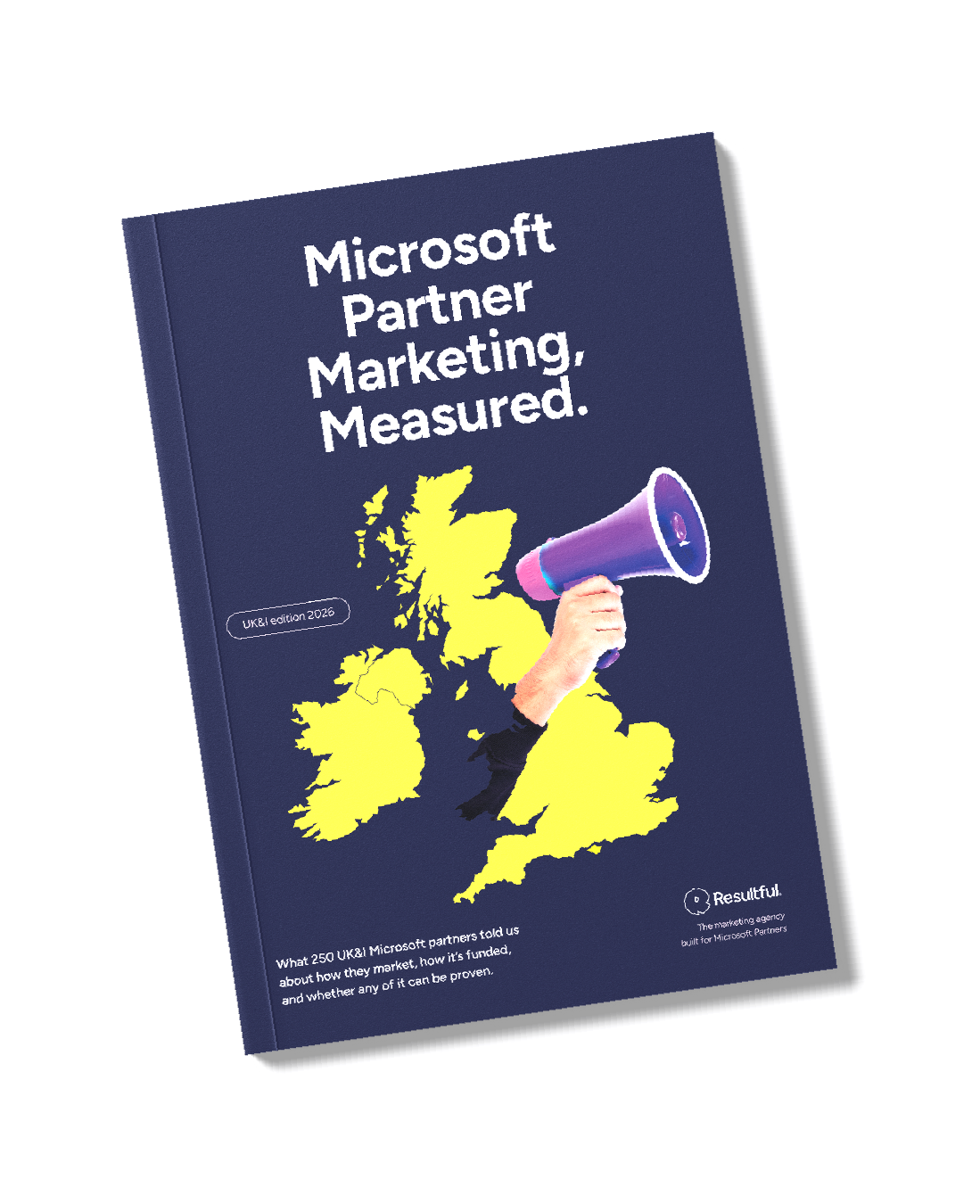
Frequently asked questions
What would happen to UK partner marketing if Microsoft funding stopped?
60.6% of Co-op or MDF-funded UK partners say it would stop or reduce: 14.9% almost completely, 30.3% significantly and 15.4% slightly.
How do UK Microsoft partners fund their marketing?
46% use Microsoft Co-op, 44.4% distributor-funded activity, 41.2% Microsoft MDF and 37.2% their own P&L.
Should partners stop using Co-op and MDF?
No. Used well, vendor funding is one of the biggest advantages of the Microsoft channel. It works best as an accelerator on top of your own investment.
What risks come with relying on Microsoft funding?
Programme criteria can change, the amount can fall, and missed deadlines or claims windows can leave you ineligible.
How can a partner check its funding dependency?
Split the last twelve months of marketing spend into vendor-funded and self-funded, then list which activities would stop if vendor money vanished.