
When budgets get tight, marketing is usually one of the first lines partner leaders look at, and it's easy to see why. It's a visible cost, the return can feel hard to pin down, and cutting it doesn't hurt anything straight away. But having looked at what 250 UK Microsoft partners told us in our latest research, I'd argue the far bigger cost is the one that never shows up on the P&L: the growth you don't get.
Key takeaways
- UK partners' top priorities are brand awareness (27.2%), better use of Co-op funding (25.2%) and winning net-new customers (23.2%).
- 27.6% say difficulty standing out holds their marketing back, and 25.2% cite over-reliance on vendor-supplied material.
- Partners' own marketing brings in 22.1% of new business, against 35.1% from Microsoft referrals and distributor or vendor leads.
- Budget ranks eighth of ten limitations (19.2%), behind funding rule complexity (31.2%) and competing internal priorities (30.8%).
- Treat marketing as an investment: your own budget line, a dedicated marketer, your own proposition and reporting on results.
What UK partners want
We asked partners to pick their top three marketing priorities for the next twelve months. At the top was building brand awareness in a crowded market (27.2%), followed by better use of Co-op funding (25.2%) and winning net-new customers (23.2%). When we asked what was holding their marketing back, 27.6% said difficulty standing out from other partners.
So, the ambition is clearly there. UK partners know they need to be better known, easier to tell apart and better at winning new customers. The question is whether they're investing in a way that will actually get them there.
The cost of sounding the same
From experience, almost every partner has something genuinely unique about them - their IP, their expertise, their closeness to a particular industry. The issue is that very few bring it to life through marketing. A quarter of UK partners (25.2%) told us over-reliance on vendor-supplied material is limiting them, and when hundreds of partners share the same solutions, the same status and the same Microsoft messaging, customers can't tell them apart.
And when a customer can't tell you apart from the next partner, the conversation comes down to cost rather than capability. That's the real price of under-investing in marketing: you end up competing on price in deals you should be winning on expertise.
The cost of relying on others
On average, UK partners told us marketing they generated themselves accounted for 22.1% of their new business. Microsoft referrals and distributor or vendor leads together brought in 35.1%. Referrals are brilliant, and a strong Microsoft relationship is well worth having, but it does mean a lot of partners' growth is sitting in somebody else's hands.
With Co-op now rewarding growth rather than retention, that's a riskier place to be than it was. Partners who can't create their own demand will find it harder to hit the growth that keeps the funding flowing, which is a cycle that's much easier to avoid than to break.
Money isn't really the blocker
Here's the finding that surprised us most. Budget came eighth out of ten in the list of things limiting partner marketing, chosen by only 19.2% of UK partners. Competing internal priorities (30.8%) and the complexity of funding rules (31.2%) came well ahead of it.
So, for most partners, the bigger step is deciding that marketing is worth protecting, and treating it as an investment in growth rather than a cost to be trimmed whenever things get busy.
What investing in growth looks like
Treating marketing as an investment rather than a cost centre changes the way you make decisions about it. Instead of asking "what's the least we can spend?", you ask "what would it take to become the partner our customers choose?" In practice, that tends to mean:
A deliberate line in your own P&L for marketing,
so your growth isn't dependent on vendor funding.
Somebody whose whole job is marketing,
with the time to do fewer things properly.
A proposition that's genuinely yours,
told in your own words rather than adapted vendor material.
Reporting that shows what marketing contributes,
so the investment can be judged on results.
The real question for leaders
Every partner leader has to decide where to put the business's money, and marketing will always compete with other priorities. But standing still isn't free. It costs you the customers who never heard of you, the deals you lost on price and the growth you'll need to keep your Co-op flowing.
Seen that way, the more useful question for any partner leader is whether the business can really afford to keep standing still.
The full data is in Microsoft Partner Marketing, Measured - The UK Edition 2026. And if you'd like to chat through what a sensible investment in growth might look like for your business, we're always happy to talk.
See how your numbers compare
Microsoft Partner Marketing, Measured - The UK&I Edition 2026. What 250 UK&I Microsoft partners told us about how they market, how it's funded and whether any of it can be proven.
Download the report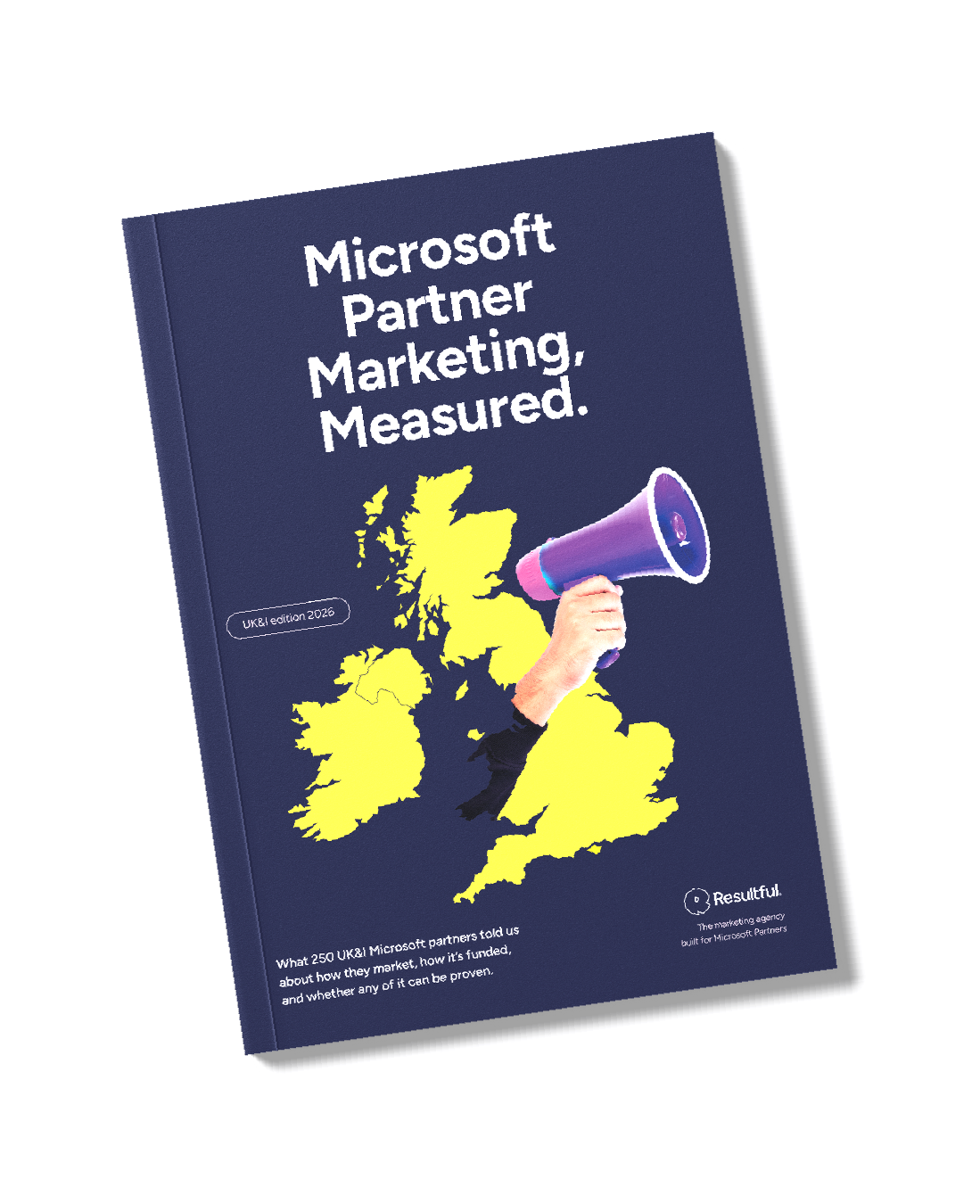
Frequently asked questions
What are UK Microsoft partners' top marketing priorities?
Building brand awareness in a crowded market (27.2%), better use of Co-op funding (25.2%) and winning net-new customers (23.2%).
Is budget the main thing holding partner marketing back?
No. Budget ranks eighth of ten, chosen by 19.2%, behind the complexity of funding rules (31.2%) and competing internal priorities (30.8%).
How much new business comes from partners' own marketing?
22.1% on average, against 35.1% from Microsoft referrals and distributor or vendor leads combined.
What does under-investing in marketing cost?
Customers who never hear of you, deals lost on price and the growth needed to keep Co-op funding flowing.
What does treating marketing as an investment look like?
Your own budget line, a dedicated marketer, a proposition in your own words and reporting that shows what marketing contributes.