
With Microsoft moving Co-op away from rewarding retention and towards rewarding growth, a lot of partner marketers are going to find themselves in front of their board over the coming months, explaining what marketing needs to deliver next year and what it'll cost. And if the last few budget rounds are anything to go by, plenty of those conversations will lean on the same argument: marketing is important, so please can we have more of it.
Nobody disagrees with that argument, but very few boards fund it either. So, we wanted to give marketers something sharper to take into the room, and our new UK report gives you exactly that - a benchmark built from 250 UK&I Microsoft partners, answered on their own terms.
Key takeaways
- Budget requests built around a list of activities rarely get signed off; boards fund a clear gap with a specific plan to close it.
- The average UK&I Microsoft partner invests around 3.85% of revenue in marketing, and 62% sit in the 3-5% band.
- 43.6% of UK&I partners run attribution reporting, yet only 51.2% can measure marketing's contribution to pipeline and revenue.
- Budget ranked eighth of ten limits on partner marketing (19.2%), behind funding rule complexity (31.2%) and competing priorities (30.8%).
- Pick the two gaps that matter most to your board and pair each with a focused ask and a way to prove it worked.
Why "marketing is important" rarely gets signed off
From experience, most budget requests we see are built around activity. There's a list of campaigns, a list of channels, maybe an event or two, and a number at the bottom. It makes perfect sense to the marketer who wrote it, but if you're the business leader reading it, you're being asked to approve a shopping list rather than a decision.
What moves a board is a gap - a clear difference between where the business is and where it could be, with a sensible, specific plan to close it. Benchmark data is one of the quickest ways to show that gap, because it takes the conversation away from opinion ("I think we should do more") and towards evidence ("partners like us are doing this, and we're not").
What 250 Microsoft Partners across the UK&I told us
Resultful commissioned Censuswide to survey 250 decision makers within Microsoft Partners between 26 August and 4 September 2026. Every respondent works at a partner with between 50 and 1,000 employees, where at least half of revenue is tied to Microsoft, and everyone who answered holds a senior sales, marketing or leadership role. That makes it a genuinely useful mirror to hold up to your own business, rather than a global number with the UK&I folded into EMEA.
Four gaps worth looking for
When you read the report with your own numbers alongside it, a handful of comparisons tend to jump out. Here are the four we'd look at first, with the kind of sentence you could take straight into a budget meeting.
Investment
The average UK&I partner invests around 3.85% of revenue in marketing, and 62% sit in the 3-5% band. If you're at 2%, you're in the bottom quarter of the market - 25.2% of partners invest only 1-2%.
Attribution
43.6% of UK&I partners run enhanced reporting with attribution, so they can see which activity actually influenced a deal. If you can't, you're behind a sizeable chunk of your competitors on the one thing that protects budget.
Planning
Three quarters of UK&I partners have a documented marketing plan, but only 45.6% say that plan is directly aligned to business goals. If you don't have a plan at all, you're in the minority; if you have one that isn't tied to what the business is trying to achieve, you're in good (but not great) company.
Measurement
Only 51.2% of UK&I partners say they can measure marketing's contribution to pipeline and revenue. If you're running nine or ten activities and can't show what any of them contributed, that's the gap to lead with.
Turning a gap into an ask
A benchmark on its own is just an interesting fact, so the trick is to turn it into a proper request. We'd suggest a simple structure for each gap: where you are, where the market is, what that gap is costing you, and exactly what you'd do with the investment - including how you'll know if it worked.
For example, rather than "we need more budget for reporting", try something along the lines of: "Fewer than half of UK partners run basic reporting, but 43.6% have attribution in place. We don't, which means we can't tell you which of our campaigns generated last year's new business. We'd like to invest in tracking inside our CRM, and in six months we'll bring you a monthly view of where every enquiry came from." That's a very different conversation to a line item.
A word of caution before you go in
There's one finding in the report that's worth being honest about, because your board may well have read it too. Budget came eighth out of ten in the list of things limiting partner marketing, chosen by only 19.2% of UK partners. Complexity of funding rules (31.2%) and competing internal priorities (30.8%) came well ahead of it.
So, don't use the benchmark to argue for more money across the board. Use it to show where a specific investment would close a specific gap, and be clear about what you'll stop doing to make room for it. A marketer who comes to the table with a focused ask and a plan to prove it worked is far harder to say no to than one who simply wants a bigger number.
Where to start
Pull your own figures together first - your percentage of revenue invested, whether you can measure pipeline contribution, and whether your plan is written down and tied to the business. Then put them side by side with the UK&I benchmark and pick the two gaps that matter most to your board. Two is plenty; any more and you're back to a shopping list.
The full data is in Microsoft Partner Marketing, Measured - The UK&I Edition 2026, and if you'd like to chat through how your numbers compare, we're always happy to have a no-obligation conversation.
See how your numbers compare
Microsoft Partner Marketing, Measured - The UK&I Edition 2026. What 250 UK&I Microsoft partners told us about how they market, how it's funded and whether any of it can be proven.
Download the report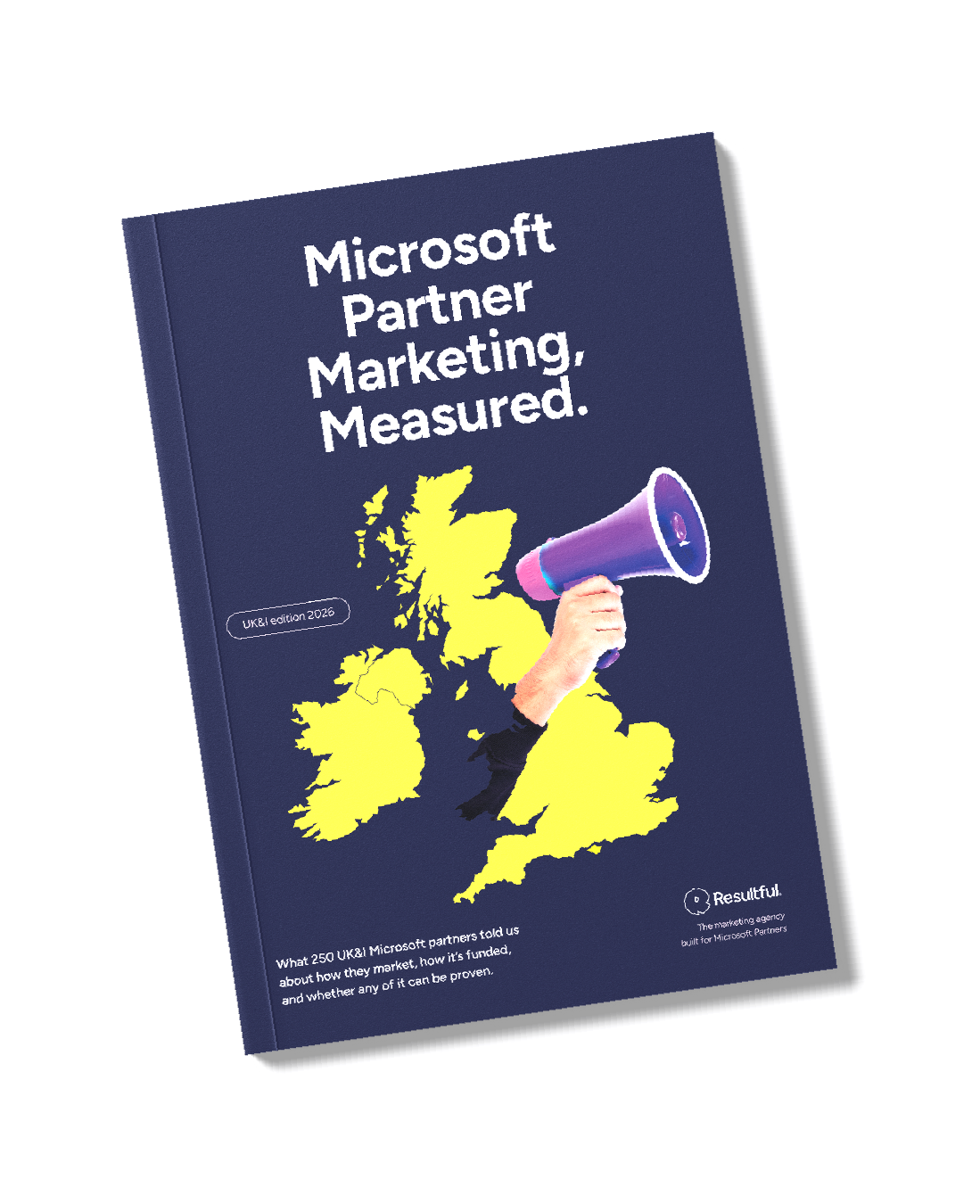
Frequently asked questions
How much do UK&I Microsoft partners invest in marketing?
Around 3.85% of revenue on average, with 62% investing 3-5% and 25.2% investing only 1-2%, according to Resultful's survey of 250 UK&I partners.
How many Microsoft partners can measure marketing's impact?
Only 51.2% of UK&I partners say they can measure marketing's contribution to pipeline and revenue, and 43.6% run enhanced reporting with attribution.
Is budget the biggest thing holding partner marketing back?
No. Budget ranked eighth of ten, chosen by 19.2%. Complexity of funding rules (31.2%) and competing internal priorities (30.8%) came well ahead.
How should a partner marketer structure a budget request?
For each gap, set out where you are, where the market is, what the gap costs you, and exactly what you'd do with the investment, including how you'll prove it worked.