
Think about how a law firm or an accountancy practice funds its marketing. There's a line in the budget, it comes out of the firm's own accounts, and that's the end of the conversation. In the Microsoft channel, things look very different - there's Co-op, there's MDF, there are distributor-run programmes, and there's usually another vendor somewhere with a pot you could apply to if you really wanted to.
That's a real advantage, and we'd never suggest otherwise. But our latest UK research shows just how far the balance has tipped, and I'd argue it's time partner leaders took a hard look at it.
Key takeaways
- 46% of UK partners fund marketing through Microsoft Co-op, 44.4% through distributors and 41.2% through MDF, but only 37.2% from their own P&L.
- UK distributor funding is 11 percentage points higher than in the USA.
- 25.2% say over-reliance on vendor-supplied material limits their marketing.
- 45.9% of managing directors say their own P&L funds marketing, against 29.4% of heads of marketing.
- Use your own budget for the things that build your position, and use Co-op, MDF and distributor funding to amplify them.
What the data shows
When we asked 250 UK Microsoft partners how their marketing is funded, 46% ticked the Microsoft Co-op box. Distributor-funded activity followed very closely at 44.4%, with Microsoft MDF at 41.2%. Just over a third (37.2%) said their own P&L funds their marketing.
Flip that last number around and it becomes much starker. Almost two-thirds of UK partners don't count their own P&L as a source of marketing funding, which is something that's pretty much unheard of in any other industry.
Three kinds of dependency
Each funding stream brings its own strings, and it's worth being clear-eyed about them.
Co-op dependence
Co-op now rewards growth rather than retention, so partners who can't show growth may find less of it coming back to them.
MDF dependence
MDF is tied to Microsoft's priorities and approved activities, which won't always match yours.
Distribution dependence
Your distribution partner has their own goals set by Microsoft, and they're likely passing them down to you. If you hit them, they get closer to hitting theirs. It makes perfect sense, but it means a lot of UK partner marketing has three organisations' fingerprints on it.
Distributor funding is where the UK stands out most - at 44.4%, it's 11 percentage points higher than the USA figure in the companion study. The good distributors do a genuinely brilliant job of making marketing happen for partners who'd otherwise do very little, but it does mean the UK market runs on other people's priorities more than most.
Treat marketing like you treat sales
No partner leader would expect Microsoft to fund their sales team. Sales is a core capability - you hire for it, you set its targets, you hold it to account, and you invest in it because the business depends on it. Marketing deserves exactly the same treatment.
When marketing is funded mostly by third parties, it naturally ends up serving their agenda. You get the approved activity, the approved messaging and the approved timelines, and a quarter of UK partners (25.2%) told us over-reliance on vendor-supplied material is limiting their marketing. That's how a market ends up sounding identical.
The boardroom sees it differently
There's an interesting split by role here. 45.9% of managing directors said their own P&L funds marketing, compared with 29.4% of heads of marketing. The same pattern appeared on Co-op: 56.8% of MDs said it funds their marketing, against 37.3% of heads of marketing.
We can't tell you which view is right, but we can tell you that the people closest to the funding and the people closest to the spending aren't looking at the same picture. If you lead a partner, it's worth checking whether the investment you think you're making is actually reaching the people doing the work.
What owning it looks like
Funding marketing from your own P&L doesn't mean matching Microsoft pound for pound. It means making a deliberate decision about what your own money is for - usually the things that build your position and nobody else will fund. Your proposition, your own customer stories, somebody whose whole job is marketing, and the reporting that proves it's working.
Then Co-op, MDF and distributor programmes become what they should be: a way to amplify a strategy you own, rather than the thing that decides what your strategy is.
The full funding data is in Microsoft Partner Marketing, Measured - The UK Edition 2026. If you'd like to chat through what a sensible own-P&L line might look like for your business, we'd be glad to help.
See how your numbers compare
Microsoft Partner Marketing, Measured - The UK&I Edition 2026. What 250 UK&I Microsoft partners told us about how they market, how it's funded and whether any of it can be proven.
Download the report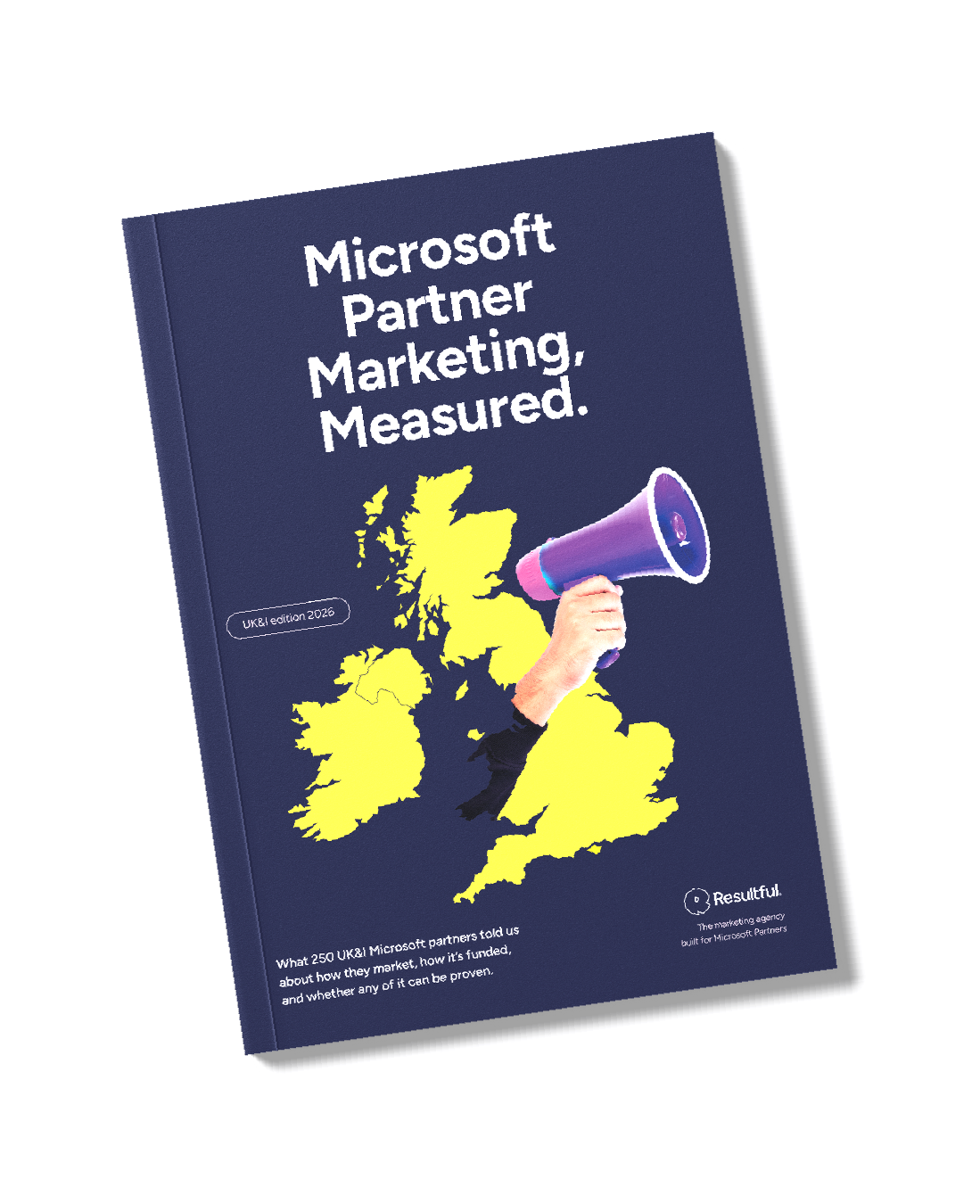
Frequently asked questions
How do UK Microsoft partners fund their marketing?
46% use Microsoft Co-op, 44.4% distributor-funded activity, 41.2% Microsoft MDF and 37.2% their own P&L.
How does UK distributor funding compare with the USA?
At 44.4%, UK distributor funding is 11 percentage points higher than the USA figure in the companion study.
What are the risks of each funding stream?
Co-op now rewards growth, MDF is tied to Microsoft's priorities, and distributors pass down goals set by Microsoft.
Do managing directors and heads of marketing see funding the same way?
No. 45.9% of MDs say their own P&L funds marketing, against 29.4% of heads of marketing.
What should a partner's own marketing budget pay for?
The things that build your position and nobody else will fund: your proposition, customer stories, a dedicated marketer and reporting.